publications
publications by categories in reversed chronological order. generated by jekyll-scholar.
2026
- Damage Adaptation in Seconds for Architected MaterialsJames Avtges, Jake Ketchum, Helena Young, and 3 more authorsIn Proceedings of Robotics: Science and Systems, 2026
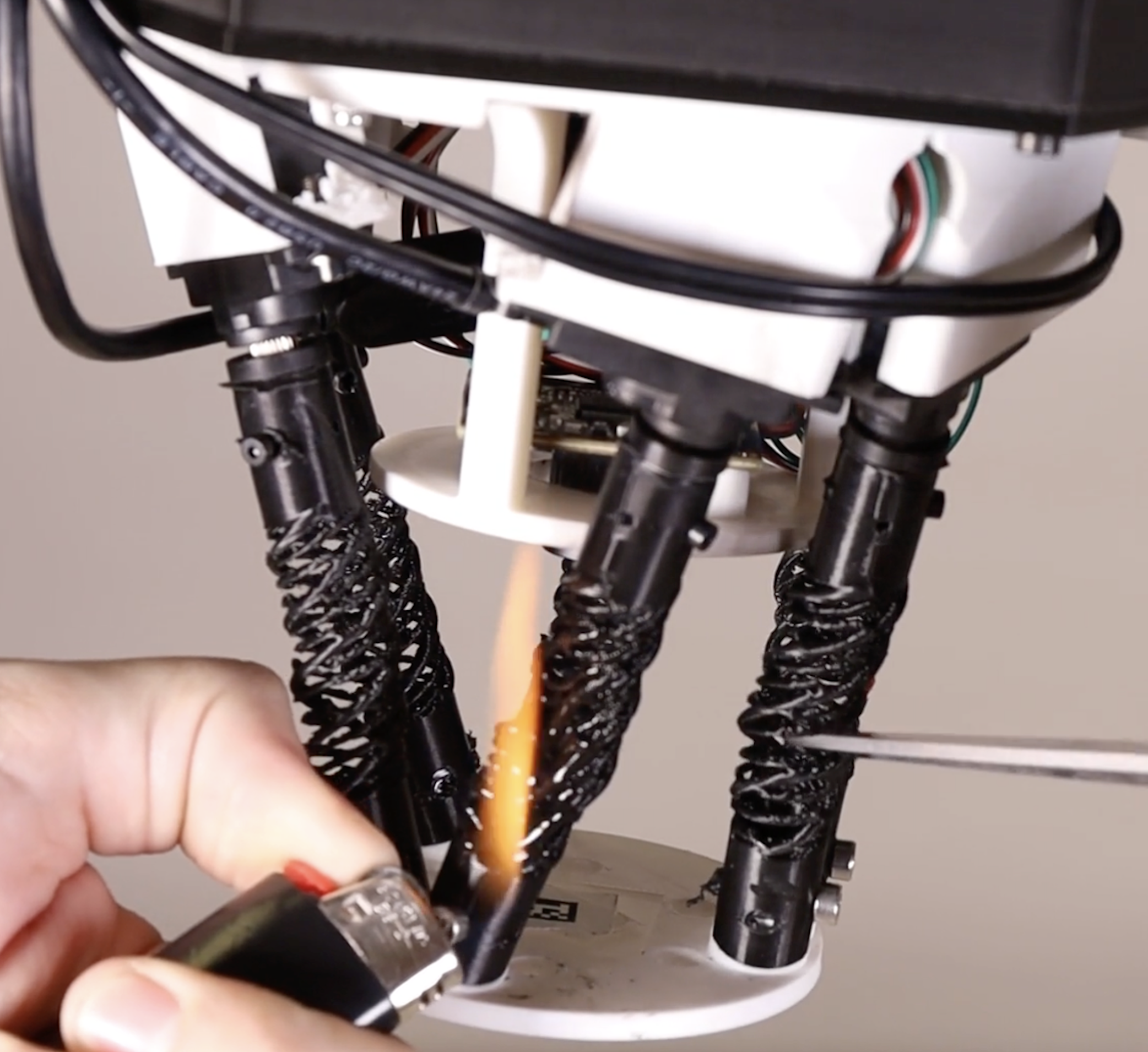
Adaptation to damages and in-situ physical repairs is essential for long-term robot autonomy, yet challenging outside of narrowly defined and well-anticipated bounds. In this work we proprioceptively adapt to catastrophic damage in soft-actuated systems in under one minute. Architected materials are well equipped for adaptation: actuator failure occurs gradually rather than acutely, and damage can be described in a low-dimensional, discrete coordinate space. Surprisingly, latent damage representations plus a simple yet robust ensemble method is sufficient for adapting to unseen damage in real-time. Moreover, we identify conditions under which exponential sample complexity collapses to linear sample complexity for learned representations of architected materials, a concrete advantage over rigid components or continuum soft mechanisms. We demonstrate LEAP, our method for adaptive proprioception, via a tracing task for a 6DoF soft wrist based on Handed Shearing Auxetic (HSA) actuators. Our algorithm is able to adapt to cuts, burns, and actuator repairs, enabling simulation-free real-time adaptation that is critical for realizing the promise of soft robots outside the lab. Videos and more information are available at https://murpheylab.github.io/leap.
@inproceedings{avtges2026damage,
  title = {Damage Adaptation in Seconds for Architected Materials},
  author = {Avtges, James and Ketchum, Jake and Young, Helena and Kim, Taekyoung and Truby, Ryan and Murphey, Todd},
  booktitle = {Proceedings of Robotics: Science and Systems},
  year = {2026},
}
2025
- Real-Time Reinforcement Learning for Dynamic Tasks with a Parallel Soft RobotJames Avtges, Jake Ketchum, Millicent Schlafly, and 5 more authorsIn 2025 IEEE/RSJ International Conference on Intelligent Robots and Systems (IROS), 2025
Closed-loop control remains an open challenge in soft robotics. The nonlinear responses of soft actuators under dynamic loading conditions limit the use of analytic models for soft robot control. Traditional methods of controlling soft robots underutilize their configuration spaces to avoid nonlinearity, hysteresis, large deformations, and the risk of actuator damage. Furthermore, episodic data-driven control approaches such as reinforcement learning (RL) are traditionally limited by sample efficiency and inconsistency across initializations. In this work, we demonstrate RL for reliably learning control policies for dynamic balancing tasks in real-time single-shot hardware deployments. We use a deformable Stewart platform constructed using parallel, 3D-printed soft actuators based on motorized handed shearing auxetic (HSA) structures. By introducing a curriculum learning approach based on expanding neighborhoods…
@inproceedings{avtges2025realtime, title = {Real-Time Reinforcement Learning for Dynamic Tasks with a Parallel Soft Robot}, author = {Avtges, James and Ketchum, Jake and Schlafly, Millicent and Young, Helena and Kim, Taekyoung and Pinosky, Allison and Truby, Ryan L. and Murphey, Todd D.}, booktitle = {2025 IEEE/RSJ International Conference on Intelligent Robots and Systems (IROS)}, year = {2025}, pages = {5537--5544}, publisher = {IEEE}, } - Sample-Efficient Online Control Policy Learning with Real-Time Recursive Model UpdatesZixin Zhang, James Avtges, and Todd D. MurpheyIn Conference on Robot Learning, 2025
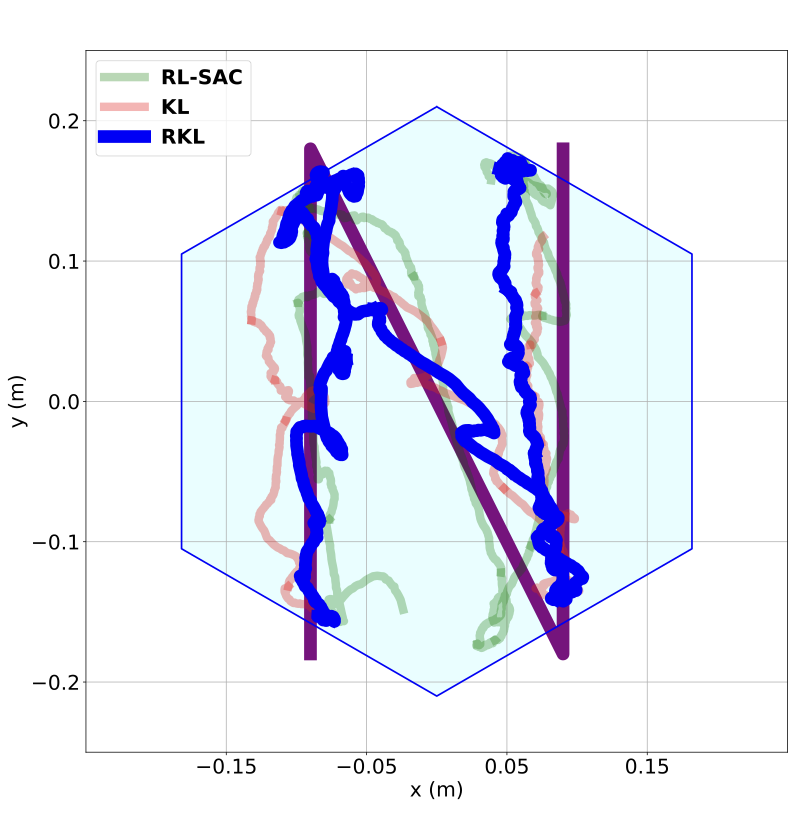
Data-driven control methods need to be sample-efficient and lightweight, especially when data acquisition and computational resources are limited – such as during learning on hardware. Most modern data-driven methods require large datasets and struggle with real-time updates of models, limiting their performance in dynamic environments. Koopman theory formally represents nonlinear systems as linear models over observables, and Koopman representations can be determined from data in an optimization-friendly setting with potentially rapid model updates. In this paper, we present a highly sample-efficient, Koopman-based learning pipeline: Recursive Koopman Learning (RKL). We identify sufficient conditions for model convergence and provide formal algorithmic analysis supporting our claim that RKL is lightweight and fast, with complexity independent of dataset size. We validate our method on a simulated planar two-link arm and a hybrid nonlinear hardware system with soft actuators, showing that real-time recursive Koopman model updates improve the sample efficiency and stability of data-driven controller synthesis – requiring only <10% of the data compared to benchmarks. The high-performance C++ codebase is open-sourced. Website: https://www.zixinatom990.com/home/robotics/corl-2025-recursive-koopman-learning.
@inproceedings{zhang2025sample, title = {Sample-Efficient Online Control Policy Learning with Real-Time Recursive Model Updates}, author = {Zhang, Zixin and Avtges, James and Murphey, Todd D.}, booktitle = {Conference on Robot Learning}, year = {2025}, pages = {1914--1939}, } - Force and Speed in a Soft Stewart PlatformJake Ketchum, James Avtges, Millicent Schlafly, and 4 more authorsIn 2025 IEEE 8th International Conference on Soft Robotics (RoboSoft), 2025
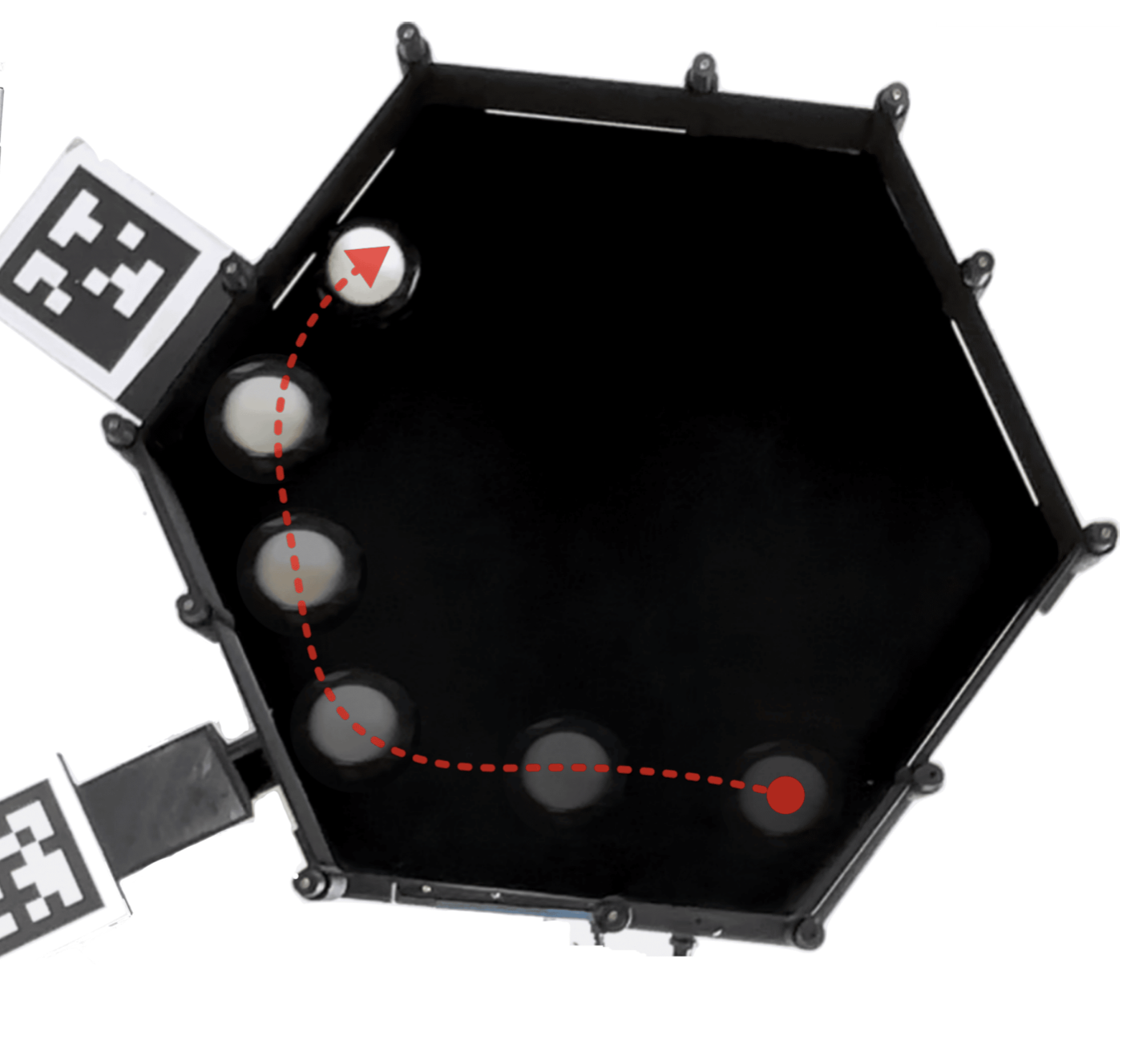
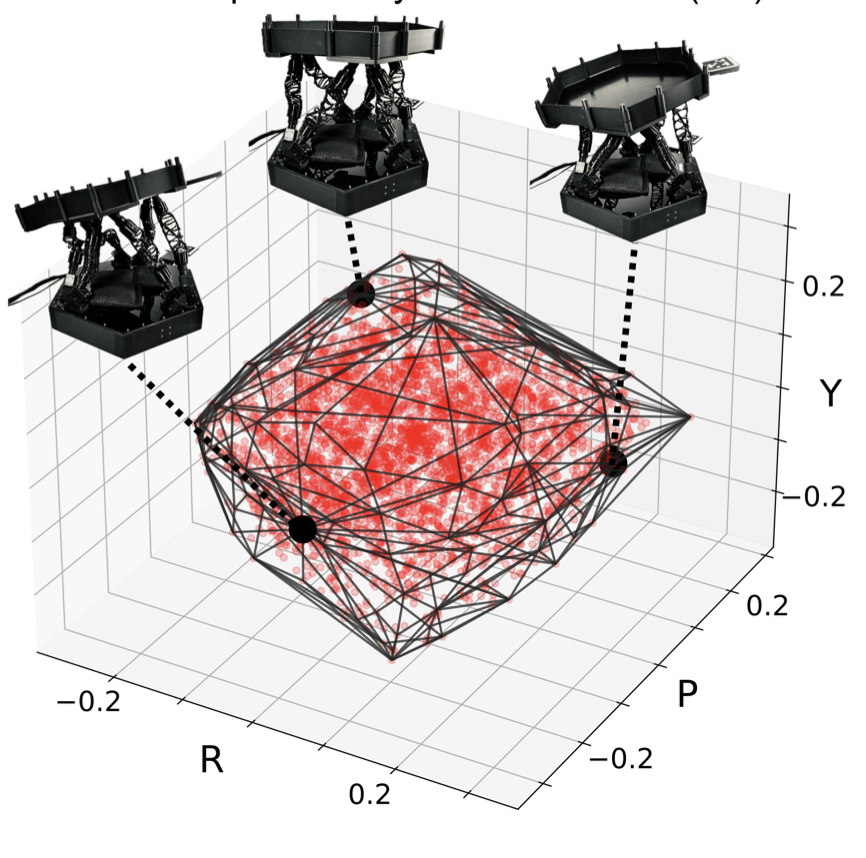
Many soft robots struggle to produce dynamic motions with fast, large displacements. We develop a parallel 6 degree-of-freedom (DoF) Stewart-Gough mechanism using Handed Shearing Auxetic (HSA) actuators. By using soft actuators, we are able to use one third as many mechatronic components as a rigid Stewart platform, while retaining a working payload of 2kg and an open-loop bandwidth greater than 16Hz. We show that the platform is capable of both precise tracing and dynamic disturbance rejection when controlling a ball and sliding puck using a Proportional Integral Derivative (PID) controller. We develop a machine-learning-based kinematics model and demonstrate a functional workspace of roughly 10cm in each translation direction and 28 degrees in each orientation. This 6DoF device has many of the characteristics associated with rigid components—power, speed, and total workspace— while…
@inproceedings{ketchum2025force,
  title = {Force and Speed in a Soft Stewart Platform},
  author = {Ketchum, Jake and Avtges, James and Schlafly, Millicent and Young, Helena and Kim, Taekyoung and Truby, Ryan L. and Murphey, Todd D.},
  booktitle = {2025 IEEE 8th International Conference on Soft Robotics (RoboSoft)},
  year = {2025},
  pages = {1--8},
  publisher = {IEEE},
}
2022
- Motorized, untethered soft robots via 3D printed auxeticsPranav Kaarthik, Francesco L. Sanchez, James Avtges, and 1 more authorSoft Matter, 2022
Untethered operation remains a fundamental challenge in soft robotics. Soft robotic actuators are generally unable to produce the forces required for carrying essential power and control hardware on-board. Moreover, current untethered soft robots often have low operating times given soft actuators’ limited efficiency and lifetime. Here, we 3D print cylindrical handed shearing auxetics (HSAs) from single-cure polyurethane resins for use as scalable, motorized soft robotic actuators for untethered machines. Mechanical characterization of individual HSAs confirms their auxetic behaviors and suitability as actuators. HSA pairs of opposite handedness are assembled to form multi-degree-of-freedom legs for untethered quadrupeds. We explore several leg designs to understand the role of length and auxetic pattern density on overall motion and blocked force generated. Finally, we demonstrate untethered locomotion with…
@article{kaarthik2022motorized,
  title = {Motorized, untethered soft robots via 3D printed auxetics},
  author = {Kaarthik, Pranav and Sanchez, Francesco L. and Avtges, James and Truby, Ryan L.},
  journal = {Soft Matter},
  volume = {18},
  number = {43},
  pages = {8229--8237},
  year = {2022},
  publisher = {The Royal Society of Chemistry},
}